Welcome sticker


Welcome to the West Wycombe Village Project Blog written by a National Trust volunteer and supported by the National Trust. If it's your first visit, find out more about the project in our about section.


Wednesday, 18 June 2014

The George & Dragon

Visit the artist exhibitions in West Wycombe Village.
I've always enjoyed the George and Dragon for its welcoming atmosphere, its mouth-watering pork-belly sandwiches but most recently for their support of the arts. It is their first year to host an exhibition by a group of five local artists. 

The George and Dragon is one of three pubs in the village and it is currently supporting the Bucks Open Studios by providing a small haven in their courtyard for painters. 

The five painters are Julia Johnson, Keith Francis, Linda Travers Smith, Pauline James, and Polly Priestley. Their work includes watercolour, acrylic, oil and pastel artwork. In previous years the group set up in the parish church rooms, but this is their first foray at the pub. The painters display until this Thursday 19 June 2014, and are open 11am-6pm. 

There is also a highly skilled jeweller in the village a few doors down at 15b, visit her or her website www.artisan-jewellery.com. 

Bucks Open Studios is an annual event held in June every year where artists and makers all over the Country open their studios or hold exhibitions and events showcasing and demonstrating their work.


Friday, 23 May 2014

Green Open Homes Event Friday 30th May

Blackboy Cottage is taking part in the Green Open Homes event.


There is a rare opportunity to take a proper peek inside a couple West Wycombe Village cottages during a Green Open Homes event next week.

The Green Open Homes network supports low-carbon open home events across the country through free resources and advice. 

On Open Home days volunteers who have made low carbon improvements to their homes share their experiences, demonstrating the benefits of renovations such as solar panels, solid wall insulation and draught-proofing.

These events take place all year round and across the country. During the month of May, homes have opened up in several places including Colchester, Manchester, Birmingham and North Oxfordshire. 

But why go that far. Come along next Friday and see close up the spectacular energy saving work on your neighbour's house. You'll get to lift the lid on the National Trust's refurbishment project and ask experts all about it.  

The national network for green open homes use a key to indicate the type of energy-saving improvements, and in West Wycombe Village these are: 
      • Low-cost improvements
      • High spec heating
      • Glazing
      • 'Big' insulation works
      • Sustainable building materials

Home page for the West Wycombe Village's Green Open Home event

Booking is required for s
caffold tours which will be taking place at 11am and 2pm on Friday 30th May.

To book on a scaffold tour of the cottage works in progress, please contact Louise Barcroft (Louise.Barcroft@nationaltrust.org.uk) at the National Trust. Because building work is involved, they need to know visitor names and numbers in advance.

Exact details of the properties will be available on the day and they ask visitors to please report to Blackboy Yard, where a member of the National Trust team will direct you to the open homes.  

For more information visit this Green Open Homes link. 

You can find an event in your area on the Green Open Homes website.


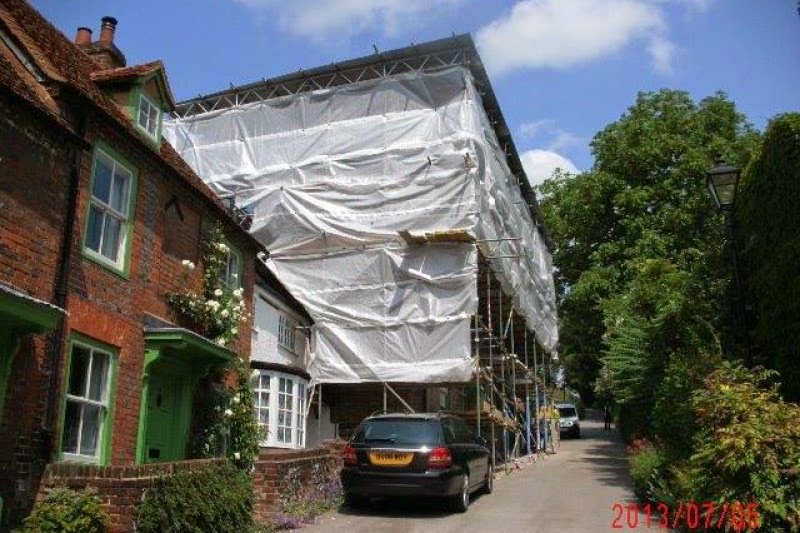
Scaffolding covering one of the energy-saving cottages.

Big insulation works were done under the roofs of these cottages.


Friday, 28 March 2014

Heritage Day: What to Expect 3rd April

Behind the scenes, National Trust Curator Oonagh Kennedy has been busy organising volunteers and their research work. 

I asked Oonagh to give a flavour of what to expect next Thursday when tenants and all of the interested general public are warmly invited to West Wycombe Village's Heritage Day. Expect something akin to tenant open days but to also see volunteer presentations about the history of the village...

As curator of the West Wycombe Village project how did you recruit the research teams? 

Oonagh Kennedy: I used the NT volunteering site to advertise that I was looking for volunteers to help research, and luckily had a very good response from people with an interest in finding out about the village.

What exactly are the researchers following, and how did these themes come about? 

We have a research group who have been visiting local archives and archives in London with information on the village from when the railway came in the mid-19th century to the first refurbishment of the village in the early 1930s by the Royal Society of Arts. 

I offered the group themes that they could explore and they each took a theme to research and write up. I also wanted an oral history done for the village and asked which of the volunteers would be interested in that – if people liked to chat, they enthusiastically opted for that. 

Finally I thought that we could think about sharing the information online in some way and our Digital Media team have taken on the challenge of doing that and have made great strides  

The research side of the West Wycombe Village project is expected to complete in one year, what are the main challenges for you and the researchers? What are the strengths?  

Strengths are easy to identify; a really keen bunch of talented researchers who are curious about the world around them and have endless energy to find out about West Wycombe Village. 

The main challenge will be to make sure that we can leave a legacy to tell  people about the village and connecting them with the life of the village and its fascinating past.

Wednesday, 12 March 2014

Building Update

Although flood signs still hang about the roadside and freshly dug trenches still form lines along farm fields, the wet winter feels behind us. Touching wood, fingers crossed, etc...

So I wanted to know how weather has affected the West Wycombe Village and asked Mark Wells, National Trust Project Manager for an update. I learned there's been no damage whatsoever to the new roofs, that they've picked up a prestigious building award nomination, and all on a very tight budget. 


The weather has been quite dramatic during this project with last winter's long freeze and then this year's gale force wind and heavy rain, how did 2013 end for you as project manager, and what would you change if you could do it over? 

Last winter was a difficult time – the snow slowed things down and made life very difficult for the guys working on site right through the winter period. However, our investment in temporary roofs ensured that works progressed despite the weather, and avoided significant delays. 

The recent severe weather was a worry over the Christmas period, as we had a temporary roof remaining at 7/8 High Street – the team were on standby throughout, and to be honest I was expecting to be called out to deal with storm damage.   It is testament to the quality of the work that we suffered no damage whatsoever to our new roofs, nor the scaffold / tin roof, despite unprecedented wind and rain – it really was the ultimate test of the roofs.  Not only are they beautiful, but they stand up to the worst the weather can throw at them.

I am very proud of what the team has achieved – we have also been nominated for an award, for craftsmanship relating to the roof work. This is for the National  LABC awards (Local Authority Building Control awards). We will find out in May if we have been successful, but it is very exciting just to be nominated.

If I were to do it over? Beg for some more money! I could not however wish to work with a better team of people – dedicated, passionate and professional. It is an honour to work with them, and an privilege to work in such a unique historic environment.

What are the main challenges for this last year ahead and how do you foresee overcoming them? 

We have a huge amount of work still to do - the emphasis this year is on internal refurbishments to 30 cottages, as well as two significant new roofs including the Grade II* Steps House. The main challenge is co-ordination and timing of the works, to ensure that disruption to the Tenants is kept to a minimum. Things change constantly, and the team has to be able to respond to changes quickly.

I have a great team working on the project, and I know they will go the extra mile to keep things running smoothly. It is a real challenge to balance the Tenant’s interests, the Contractor’s schedule, the costs, good conservation practice, unforeseen problems and complete the work on time. I am confident however that the team have the skills and dedication to deliver great results.

What is your favourite memory so far of this project? And worst? 

There have been numerous highs and lows!!! It is very difficult to pick one example. I am very proud however to be part of a team that has delivered high quality refurbishments to many cottages, and to have received positive feedback from Tenants, the Trustees, the SPAB and the Local Authority officers.  The wider project includes archaeology and our volunteer research team – both have delivered some remarkable results. I am really looking forward to our open day in April where we can share the initial research results.

The most difficult time was probably right at the start of the project – we were running late due to planning and access issues – and it took some time to get things running smoothly. We also had to deal with running out of hand made tiles halfway through the second phase of roof refurbishments.  We initially had some difficulties balancing the needs of Tenants, conservation principles and unforeseen works – not to mention the weather again and access to buildings adjacent the A40. The team very quickly got on top of the problems however, and responded swiftly to difficult issues as they arose.

Another memorable event was the NT Trustees’ visit to the project last year – they tabled some very challenging and difficult questions!  Again the team rose to the challenge, and the results speak for themselves. The consensus is that we are delivering quality refurbishment works, value for money and good conservation practice.

Monday, 24 February 2014

Save the Date! Thursday 3rd April

Have you finally stopped writing 2013 on cheques and hung up your 2014 calendar? Then please diarise Thursday 3rd April when a special event for tenants and locals in West Wycombe Village promises to inform and inspire. 

The National Trust is hosting a Heritage Open Day in the Church Rooms from 10:00am-4:00pm. All tenants are welcome to come along and see a presentation by the West Wycombe Village Historical Research Team. 

They've been a very busy bunch and will have much to share in the form of video and audio presentations with actual eye witness accounts from nearly a century ago.

  • You can learn about the arrival and closure of the West Wycombe Railway station, as well as its impact on village life. 
  • You can read and hold actual documents by the esteemed architect William Weir who redesigned West Wycombe Village in the 1930s. 
  • You can map out the spread of the village through a collection of historical West Wycombe Village maps (we've actually learned geography hasn't changed all that much!)


Come along, sit down for a cup of tea, put some audio head sets on and learn about your home. 

See you on April 3rd.

Thursday, 6 February 2014

Spirit of Place

Adams Park Community Art Project.
This week I was at the home of the Wycombe Wasps for a lunch to thank National Trust staff and volunteers like me. But there aren't many like me. I'm a young, upstart. I watched general manager Jim Foy give award pins to quite a few long serving members including a couple who have volunteered their time for 30 years. Diane and Martin Gordon have served the Trust in many ways and most recently in the Hughenden bookshop which turned over a few extra thousand pounds more profit this year.
National Trust event at Adams Park. 
To a large audience of volunteers, regional staff and national trust consultants, Jim said West Wycombe Village is an example of a place which his regional team alone can't mend.  "We need the support of the wider Trust to restore this village for generations to come and to clear the 20-plus year backlog of repairs".

There was also a general progress report on visitor numbers and survey results for Hughenden, West Wycombe Park and the Central Chilterns.


Both Hughenden and West Wycombe Park reversed a two year decline in visitor numbers. Hughenden saw 95,000 visitors while West Wycombe Park almost broke its all time record with more than 19,000 visitors last year.


Social media feedback and online sources like Tripadvisor add to a rosy picture for the visitor experience. Click here for the page about West Wycombe and here for the page about Hughenden which is ranked #1 of 17 attractions in High Wycombe on Tripadvisor. It was also nice to see the George & Dragon rated with a thumbs up. 

And apparently volunteers are happier too with the majority now saying they would recommend volunteering to a friend, compared with previous years when only a minority would spread the word.

If this interests you then c
ome along on the 15th March when the National Trust hosts an open day for volunteers and prospective volunteers.

We also heard the financial story with improved income streams from grants, catering/ retail and village income. A source called "home-grown" money grew strongly. West Wycombe Park did exceptionally well with its raffle ticket sales and per visitor ranked 2nd in the region for raffle ticket sales.

The guest speaker was Matthew Oates of the Nature and Wildlife experience. He described "Spirit of Place" which is a term I've only come to know through the National Trust.

Matthew started by asking: what is your favourite place and why?

He mentioned places such as Goring on Thame, Arnside Knott, Selborne and Wicken Fen. All places with a distinct spirit of place. Each place he said had a "Statement of significance" and an audience insight. But in a nutshell they are all places with important and emotive stories of their own.
Wicken Fens photo. Courtesy of commons.wikimedia.org

So what is West Wycombe Village's spirit of place? It's statement of significance? Having written this blog for nearly a year this is my wild guess.

It's one of England's only living, breathing and fully working ancient villages dating back to the 14th century. It's a village that's never taken a pause to reflect about age and antiquity. It's just had to get on with it and muscle on under the weight of centuries, good and bad modern developments and increased traffic through the Chilterns.

Look for sources online and on site for more information about the Volunteer open day on 15th March at Hughenden Manor.


Tuesday, 24 December 2013

A merry Christmas

I've had a rather busy month of celebration, quite a few Santa sightings and the National Trust Christmas Party in between. If you needed a reason to volunteer, their merry Christmas Party with all the trimmings would be one.


 This year the lunch party was hosted at the RAF High Wycombe where high security and the presentation of identification cards are the norm. To lighten the mood we were greeted by some of the usual staff faces displaying unusual musical talent. Who knew we had a musical archaeologist in Gary Marshall? It actually should not surprise that he had a few instruments and songs up his sleeve, as the video below shows.

Research under the Roofs 

On a slightly more business note, the new year will be a busy one but possibly more under the radar. Much of the next phase of refurbishment will take place inside the cottages and under, not on the actual roof tops.

Aside from contractors and building works, a large chunk of labour will be taking place in and amongst the village and its villagers. To feed our curiosity about the social history of West Wycombe Village,  National Trust Research volunteers led by Curator Oonagh Kennedy have been digging to unearth information about everything from the impact of War on the village to the remnants of its once bustling railway station. 


Oonagh's volunteers meet regularly to download interviews and upload them onto a digital database. These audio and visual accounts in the form of recorded interviews, photographs and video will be one of the many lasting legacies of the West Wycombe Village Project. 

I'll hope to share the developments here on the blog in the new year.

I wish you a happy Christmas and to see you in 2014.

Wednesday, 27 November 2013

Thanksgiving and the holidays

The last Thursday of November is Thanksgiving in America where essentially people gather for an English style Christmas but they do it one whole month earlier. This is probably only relevant to expats like me but everywhere I look the Christmas holiday gears are churning. And why shouldn't they with only four Sundays left before Christmas day.

In West Wycombe, the project management team have been discussing the construction work over the holiday season. After last year's blistering winter, Project Manager Mark Wells prefers no roofing works to occur during January and February. This could be welcome new year news to residents who want a warm roof over their heads. Mark has been pushing the contractors to a deadline so they've been working like the clappers to finish by the end of this month.

After I mentioned floods and typhoons last time, I can report that West Wycombe Village held up during the recent storm and was left virtually unscathed.  In my neck of the woods the storm which left a couple fallen trees and many in my neighbourhood without power but West Wycombe had no structural damage. Even the scaffolding held up.

In fact, the scaffolding may even remain over the holidays if the Parish Council have their request granted. Apparently they're asking the National Trust to keep some scaffolding up so that they can place their Christmas decorations. How's that for functional and decorative.

Important but slightly more mundane matters discussed included contracts and the Long Term Cyclical programme which covers budget and expenditure. Much thought and consideration is being given to the second half of this refurbishment project and what can be achieved based on the money available.

I must be brief this week. I've got lots of birds to roast, heaps of food to cook and plenty of reasons to be thankful.

Tuesday, 12 November 2013

Floods

I am quite unexpectedly in the National Trust offices today writing a blog post about floods. 

It's a beautiful sunny autumnal day and I was meant to be home, getting on with chores and maybe doing some laundry. But my neighbours are having some earth-shaking drilling done to fix their water mains. Unfortunately, despite having lived in noisy cities, I can no longer seem to bear bone rattling sound. 

This quite minor inconvenience made me think about the tenants of West Wycombe Village who have patiently if not cheerfully adjusted their lives because of the recent construction work. 

For further perspective I thought of the happy and spirited Filipinos. Despite the devastation in the Philippines 
where at least 10,000 people are feared dead and survivors are desperately waiting for aid after the recent typhoon destroyed their homes and villages, their undying spirit, hope and smiles remain.

Just aside, my family in the Philippines are quite fortunate and unaffected. Like many, this leaves me sitting on the sidelines reading the news like a spectator seeking ways and means to help.


Back to the West Wycombe Village and the National Trust. 
I found my silver lining, peace and quiet at their offices this morning. 

I learned a bit more about the great flood of 1936 and these photos give a flavour of its impact in West Wycombe Village. Following a three week drought in May, torrential rain considerably flooded West Wycombe and Piddington. The High Street was flooded to a depth of several feet and the Oxford to London Road was blocked by earth and chalk that had been washed onto the road. 

(The men below are standing on a water trough for horses.)

High Street in front of the Swan Inn, 17th May 1936.  Photo by Ron Goodearl of Desborough Ave.

High Street in front of the Swan Inn, 15th April 1931.
Our area has four significant rivers and streams: the River Wye, the Hughenden Stream, the Hamble Brook and the River Thames. Smaller ones include the Lyde and the Bonny & Elm Brooks. 

West Wycombe Village is nearest the River Wye fed by a chalk spring between Chorley Farm and Cockshott Farm. From its source, the Wye is 17 kilometres long and flows steeply south-east towards and through High Wycombe. In 1965, most of the Wye was culverted or channelled underground through a tunnel under much of the town centre. 

Culverts can cause bottlenecks and flash floods. But the safety nets for our river and any potential flooding are the Rye and partly the lakes of West Wycombe Park which act as designated flood storage areas or as functional floodplains. 

Although no major flooding has been recorded since 1936, floods can still strike, especially with our recent erratic weather. 

The Parish Council archive shows it focussed on maintenance projects in 2008 such as flooding outside the Swan Inn which has the lowest ground level point in the village. 

But in the end, Richard Fillmore explained that any flooding nowadays is more likely to be caused by urban motorway paving and climate change. 

Thursday, 24 October 2013

Digging around West Wycombe

The National Trust has uncovered evidence of what may be an early manor house pre-dating West Wycombe Park within West Wycombe Village.

National Trust archaeologist Gary Marshall has discovered using tree-ring dating that cottage number 25 dates back to 1531-32. And the adjacent no. 24 is an even older building, possibly the remains of an early manor house for the Bishop of Winchester. During the Middle Ages, the Bishop’s diocese, based in Winchester Hampshire, was one of the wealthiest.

Winchester Cathedral: Wikimedia Commons
The Bishop would have been lord of this early manor until the time of the Dissolution. No. 24 lies directly opposite the Church Loft, recently dated by tree-ring analysis to 1465. It would appear that the core of the medieval village was actually to the east (High Wycombe end) and then expanded westwards and north toward the hill and caves.

Gary Marshall shared this revelation and other thoughts with me about the historical complexity and gradual evolution of West Wycombe Village.
Gary Marshall, National Trust archaeologist on the roof

NV: How did you become involved with the West Wycombe Village project?
GM: When the project was conceived a few years ago, it was considered to be quite invasive into the buildings and so the surveyor approached me asking about the archaeological implications. We had to bear in mind that you’ve got 23 listed structures as a collection of buildings of great historical significance illustrating the evolution of timber framed buildings from the late 15th century through to brick buildings of the 18th and 19th centuries.

We had to consider the archaeological impact. We had to consider what we knew about the buildings and consider what opportunities might arise for further understanding the village. We knew it would mean taking roof coverings off and further invasive work. If we were removing historical fabric because it had decayed or because of necessary upgrading we would record evidence before it was actually removed. Yes, it was a great opportunity.

And how has this compared with the other projects you have worked on, what’s unique about this?
There were buildings in West Wycombe we had looked at piecemeal in the past and we have the studies of the vernacular building surveys (VBSs) from the 1990s so we already had a core of understanding and evidence for the buildings. But by taking the roofs off, we were looking deeper inside the buildings. Of course we've also got the opportunity to try and get more accurate dates for the buildings through the dendrochronology dating (tree ring dating which measures widths in the growth rings of the timber to determine when it was felled).

Dendrochronology drilling (courtesy of Wikimedia Commons)


This far into the project, can you describe the archaeological impact, the risks and opportunities?
We've had great opportunities to look at the timbers. We’re looking at the types of joints in the timbers and the type of timber they actually used - how it’s been configured and used. But we also get to look at the phasing of the roofs because you can actually see the relationship between timbers and work out how the roofs have evolved. We’ve asked: are they just one phase or are they more complicated than that? And the dendrochronology dating has thrown up some surprises that we might not have known about before. Approximate dates had been given by the vernacular building surveys and where we've been able to get dates we’ve now got much more accurate assessments of those buildings.

One of the frustrations has been that some of those roofs just haven’t dated, even though we've got fantastic old looking big timbers which you might think are suitable for dating. The problem is that the ring structure is such that there’s not enough rings in the timbers or the pattern is too fast grown for the dendrochronologist to asses them properly. 

How long have you been working with dendrochronology dating?
Quite a few years. In fact some of the earliest opportunities I’ve had for dendrochronology were in West Wycombe. It was number 25 on the High Street where we had a date from the 1530s. The technology gives us the chance to accurately put dates on things you would be guessing at otherwise.

Have there been any surprises?
The Crown Court complex is the more challenging property. We know from previous assessments that cottage number 24 is a very significant building. When the timber frame was looked at some years ago we recognised some quite elaborate moulding (shaping on the beams) which is something you wouldn't put on a building unless it was significant with someone who had money to invest in high quality carpentry. A standard domestic building is not going to have elaborate mouldings so we knew it was a building of some importance.

With the tenants’ permission, we went into that building recently to have a look around and I think the dendrochronologist (Dr. Dan Miles of the Oxford Dendrochronology Laboratory) has recognised that he can get some good samples so we’re hoping we can get some good dates.

The style of moulding is not dissimilar from what we’ve got in the Church Loft on the other side of the road which dates to 1465. And so I imagine that he’s going to come back with a late 15th century date.

The other interesting thing about that cottage is that when we looked at it ten or 12 years ago, we realised the framing was actually an internal frame for a building that extended westward so we’ve actually lost quite a lot of the original building. We probably lost the high status bit which would have been something like an open hall. I think we might be looking at the early manor house pre dating the existing house West Wycombe Park.

(Below, some detailed elevation drawings of the possible late 15th century timber frame in the west facing front of 24 Crown Court. Gary thinks this frame would have been one of the bays of an open hall house and that it originally extended further west into the car park.)
Elevation drawing of Cottage 24 Crown Court

Elevation drawing of 24 Crown Court
That’s really very interesting. Who would’ve lived in this manor? Crown Court is across from the Church Loft and faces the village hall, is its location significant?
At that time if it is late 15th century then the estate was owned by the Bishops of Winchester. They would have been lords of the manor and may have been represented by a Steward living in the house. And it’s interesting to look at the relationship between that building and the Church Loft on the other side of the road which housed the Church business. They’re directly opposite each other. It looks like the core of the historical village is actually at the east end and probably expanded westwards up toward the hill.

Crown Court is one of a group of buildings so we’re getting quite interesting dendro-dates from the other bits. We had a 1648 date for part of it – no. 35 facing onto the High Street. The timber framing of the carriage archway as you come into crown court has been dated to 1543, and we’ve got a 1561 date for number 27.

(In the first photo below, Gary pointed out the smoke blackened rafters of 27 Crown Court were dated to 1561. But there's a discrepancy and he thinks the roof was rebuilt later. That's because the soot goes all the way to the 'outdoor' end of the rafter rather than stopping where the soot would have been contained internally.)
Exposed rafter beams in the roof of #27 Crown Court 

Exposed roof of #41 Church Lane, its 1920s roof with the earlier 18th century purlin (horizontal bracing beam) beneath
Are the puzzle pieces and dates coming together as you had expected?
Not sure they are really. There’s some complexity because it’s not one single phase. You’ve obviously got lots of layers and a gradual evolution of these buildings as they’re added to and altered. I would imagine that at the core of it is the historic building of number 24 which has expanded eastward. And then you’ve got this 17th century layer added to it. And the date is quite interesting because it falls within the period of the civil war. You might question why there’s a major phase of building going on during this sort of national hiatus. It’s called the English Civil War but of course Scotland and Wales were involved so people now call it the British civil war rather than the English civil war.

Lots of building work during a major war is very interesting. Each of your discoveries opens another story, but more questions too. Can we go back to dendrochronology and why it’s controversial amongst some building purists?
The technique is slightly destructive in the sense that you take samples out of the timber and once you’ve extracted those samples they won’t go back into the building. But the amount of timber that you actually take out is absolutely minimal – it is pencil sized and you take only 6 or 8 samples if you want to spread your sampling around that building to get an accurate corroboration of the timbers.

The Church Loft is a good example where we were able to take 3 samples out and only one of those had the bark edge which is the last growth ring and gives the felling date for the timber. The other two timbers didn’t have the bark edge because it was removed when the timber was placed into the building.

The heartwood/ sapwood boundary is the start of the bark and you can extrapolate – you can generally add nine to 30 years for the bark that you’ve lost. The boundary date that the dendrochronologist got fits within the chronology, or in other words it confirmed that these three timbers are very accurate for the 1460s period.

Does dendrochronology work on all wood?
You need oak timbers because they grow consistently. You can occasionally date elm timbers and pine but it’s most successful with oak.

Are all the West Wycombe Village cottages oak?
Yes, I think so. The only one that was slightly surprising was 40-41 Church Lane. That’s a very interesting building because it is a small sized cottage and some of it was oak but there was also quite a lot of elm in it too.

You can see by the relationship of the timbers and even in the brickwork how the building has been extended northward up Church Lane. At the core, there’s a rafter construction which fits together quite neatly and then it’s abutted by other timbers of elm. We wanted to get dates from that roof because its structure has the sort of appearance of a late 16th late 17th century roof. But unfortunately it didn’t have enough rings. It’s really disappointing that we couldn’t get dates. Dan (the dendrochronologist) has taken some from the floor inside the building which might help to date the wood. It started out as an 16th century timber frame and then became encased in brick, and then enlarged in the later part of the 18th century. It’s surprising how a small building like that can be extended on a number of occasions.

It’s also interesting because the base of the building has a flint plinth and on top is a brick coursing and capping with elaborate moulding around two sides of the building. I just wonder whether it might have started out as something other than a cottage. On the top of the brickwork there are some openings in the gable almost a dovecote so it might’ve started out as an agricultural building or a barn or something like that. It’s quite intriguing.

Quite often with these buildings you get lots of evidence that can suggest different uses. But actually trying to confirm it can be quite difficult.

In 24 Crown Court the moulding suggested a high status manor house but in 40-41 Church Lane the moulding suggests something different.
Yes the Church Lane building moulding is on the brickwork so it’s a sort of finishing detail that suggests they’d gone through a lot of care with the construction and you can see it in the flint plinth. It’s quite well built.

I’m trying to connect the timeline dots. Going back to the east side of the village and Crown Court as the likely centre of the ancient village what about the West side – the hill and the church, mausoleum?
The mausoleum on the hill is much later - mid 18th century around the 1750’s. You’re looking at about three centuries later - after the Church Loft and Crown Court for its development.

Of course we found the Roman graves going up Church Lane which we think are late third century. I suppose the trouble is between that date in the 3rd century and the dendrochronology dates of the 15th century basically you’ve got a gap of about a thousand years in terms of our knowledge. That begs the question: did occupation continue within this West Wycombe environment and if it did we don’t have the evidence for it.

There is this large gap in the early medieval period when you just don’t get any pottery or occupation evidence or anything like that. It’s missing from the archaeological record.  I guess one of the problems is there hasn’t really been that much recorded archaeological evidence and archaeological excavation into the ground which might reveal the sort of pottery and artefact evidence.

I’m sure there was settlement and I’m sure there was continuity. The St Lawrence's Church has fabric dating from the 14th century so if you’re building a church on a hill it is going to be associated with an established settlement. We just haven’t found the evidence. I guess to some extent the development of the later village from the 15th century onwards would have stripped away the earlier occupation evidence.

After finding Roman remains in the graves on the hill, one of the biggest questions is where was this Roman settlement? When the West Wycombe Park lake was dredged up in the 1990s, an awful lot of pottery evidence was found, and a significant scatter of Roman coins. In the early 1990s there was a lot of artefact material found but not actually recorded. There’s probably a villa somewhere in the village that’s never been actually identified. It’s probably lower down within the Park rather than up the hill it just probably hasn’t been found yet.

Is it something the National Trust would actually do as a project?
I suppose it would be on our wish list to investigate further. Whether that would be through geophysics or trial trenching - it’s something we’d like to do. It would require funding and might not be on our list of priorities at the moment.

In terms of this project and its priorities to refurbish how has this compared with other projects and properties you’ve worked on?
I suppose quite often we find that we’re looking at the whole of the building and the tenants are not actually in residence. In some of the West Wycombe Village projects they’re actually only working on the roof, so the tenants will be staying there and we don’t always get a chance to look inside the building. Ideally we’d be looking at the whole building and interiors. Having said that, the 1990s building surveys did that initial assessment for us.

How much are you using the National Trust’s Vernacular Building Surveys (VBS) from the 1990s in your current work?
An awful lot. They’ve given us a frame work for understanding the evolution of the buildings and the roof recordings. Dendrochronology is testing those existing assumptions. The surveys are generally accurate in terms of understanding the evolution of the buildings, and in terms of which bits were built earlier and which bits were built later. The part we’ve had to challenge is the accuracy of their dates. So they would probably be assigning dates to first half or second half of a particular century whereas we can be more accurate.

Dendrochronology has been developed since the 1960s but I think it was just a financial thing. There may not have been the funds at the time that the 1990s surveys were completed.

Nowadays if we were looking systematically at a whole village complex like that and undertaking a thorough survey we probably would build dendrochronology into the analysis.

Oonagh (Oonagh Kennedy, National Trust curator) has looked at the RSA’s restoration in the 1930s, what do you think about their work and today’s project.
When the RSA did their work they weren’t thinking about archaeological recordings or evidence. I suppose that illustrates the difference in thinking between how we’d approach building renovation now and how we might have approached it in the 1930s.

How is modern thinking different?
The architects who would have scheduled the repairs in the 1930s would have assessed significance but not actually in a systematic way. What we don’t have is the sort of record of their thoughts or process.
Now we appreciate that one of the reasons for looking, carrying out a thorough assessment is so that we can identify those significant layers. So that when we make future decisions about which historic fabric is significant, and which is not so important then we can make those sort of value judgements about what we should or shouldn't be removing from a building.

In the 1930s they must have gone through that thought process but not actually captured it on record, at least not in a systematic way.

As you've been with the NT for nearly 30 years, how else do you think archaeology has changed through time? Sorry for the reminder of years and the abstract questions.
It’s been 26 and a half years. Thanks.

Although the technology and scientific techniques existed then, there’s a greater use of them now, dendrochronology is just one example. And I think dendrochronology is developing. They’re building up better chronologies so that in the future it might be possible to re-evaluate some samples that probably didn't date very well.

Probably too, the quality of CAD drawings to show phasing with colour. And I suppose you’re using cumulative knowledge. So there’s an understanding of timber framing and techniques that’s been developed since the 1930s or earlier.

What is on your wish list for this project and from your perspective what should the future hold for WWV?
I suppose the approach is at the moment very building by building specific. The next stage is to use the evidence to try and build and synthesise it into an overall village and parish understanding. And I think you’ve asked me before some quite interesting questions which we don’t have the questions to.

We’ve got a Roman layer, a Post-Medieval layer. But actually what happened in the intervening period? Why were the Romans interested in an Iron Age hill fort? There are several thousand years of occupation we need to understand and also what’s happened to the present day. So we need to start thinking about documentary evidence for the village. Particularly why there’s a phase of major construction in the village in the 15th century.

The civil war period is from 1642 to 1649 and we’re talking about more than a century earlier. The major phase seems to be 1460s to 1600. What stimulated that major phase of construction? What are these buildings and what’s their relationship with the road. Some of the suggestions are that the village was owned by the Bishops of Winchester. But were they actually planning a town and planning to expand it so it might have rivalled High Wycombe? As owners of the manor they would have rented properties out and were looking to create an income. Were they doing that commercially by leasing plots, building shops and commercial premises? The commercial side needs more research.

The documentary evidence is suggesting lots of commercial activity, particularly retail activity. These were rental surveys. We know from a mid 18th century map there were 8 inns catering to road travellers. I guess those inns were going to have associated crafts and activities like blacksmiths’ shops. We know there was lots of leather crafting to do with saddle shops. We found leather waste suggesting a shop making or repairing saddles. Lace making was quite significant in the village too along with bakeries, joineries and woodworking shops.

The village has had many changes, but we’re trying to pinpoint the main reason.

It’s that process of change. If you look at it now, it still has a number of commercial premises. It still has a post office, pubs and shops and several architectural practices so it still has a commercial core to it. And the nature of those activities would have stayed the same like the pubs but some have changed to reflect 21st century use. But the core is still the road. If the road wasn’t there it would be a dormant village and probably just cottages and houses not the commercial side as well. The road gives it that commercial stimulus.

Last question, do you think it would survive well without the road?
I think some of those businesses wouldn’t survive without it. It’s critical to some of them. I suppose it’s the tourism aspect too with West Wycombe  Park and the caves.
(July 2013)


Wednesday, 9 October 2013

Tenants filmed at home in West Wycombe village

After two previous posts about landlords, tenants and how tricky their relationship can be, I thought there was nothing left to say. But like gold dust landing on my blog, I received a message from Mark Wells about a video of West Wycombe village tenants. 

Last week the National Trust press office filmed long standing tenants expressing their feelings about the Trust as a landlord. I'm quite pleased to share these candid and honest views here. Click play or just read the interviews which I've transcribed below.  


National Trust Tenants at West Wycombe Village


Mark Wells, National Trust Project Manager: The Trust owns approximately 70 properties in West Wycombe Village. It's not quite the entirety of the village. There are some freehold and commercial properties in the village as well. The 58 residential properties need full refurbishment. Perhaps the most significant improvement is the re-roofing on approximately 30 of the cottages. 

Vicki Smith, National Trust tenant: I should think a couple of months before it all started [the Trust] invited us all in to see what we're going to do. It was all a bit "I can't believe this is going to happen." And so when it did come to your turn you were still all a bit shell shocked and "Oh this is going to be absolutely dreadful". But actually they worked with us all of the time. And I think talking to the majority of the tenants that have been through it, we're all really pleased. 

I've always found them very good to talk to. Always ready to listen to what you have to say. They've always had restrictions by money, so you have to bear that in mind. But really I've always found them really good. 

Jane Shilton-Brown: I've been a tenant of the National Trust now for oh..twenty-one years. The property has been done up and it is absolutely fantastic. Before it even started the Trust came round to have a look and they told me exactly what they were going to do. I have at no time found that I have had any difficulty with the Trust. When I have had a problem it has been dealt with as soon as it has been possible to do so and with the greatest respect for what I have asked for.  

Alan & Elizabeth Argent, National Trust tenants: I've been with the National Trust since 1970 and if I didn't like them I wouldn't be here now. I think they're alright as a landlord. Absolutely adequate. I really really can't fault them. 

(October 2013)

Thursday, 19 September 2013

Tenants, Landlords and the Cottages

I've heard there are two sides to every story and it takes two to tango. But with National Trust tenants and landlords I'm starting to gather there's a third complex member of the relationship. And it makes sense. The cottages are centuries old and have real life stories of their own. 

After talking with Cliff Percival about Landlords, I had a good chat with Julie Borrow, Surveying Technician for the National Trust about tenants and their homes. 

Like Cliff, Julie has been involved with informing tenants about the refurbishment project but Julie's role is also more personal and involved with direct letting. I was very interested in her perspective of West Wycombe Village.

NV: Your role is directly involved with tenants and supporting the National Trust as a landlord, how did you get started?
JB: I’ve known the tenants of West Wycombe Village for quite a long time. I started off working with Richard Wheeler who is now a National Specialist in Garden History at the National Trust.

Richard is a great ambassador for the National Trust. He has a passion for historical things especially gardens, buildings, and park lands. He instigated this passion and enthusiasm in me right from the beginning and encouraged my endeavours to follow conservation of buildings and landscapes.

When he was working with West Wycombe Village, Park and Hill, I was involved only as his secretary but that’s when I started to get to know the village tenants.  It is where I started helping tenants to understand that the works being carried out aren’t just for them or just for the building, but for both. Even if they’re not there for more than a year, they’re still custodians of those cottages.

 We want to give tenants the best, and we want them to give the cottages their best. We want them to feel enthusiastic about the cottages; I think most of the time we are succeeding in doing that.

N: It makes sense that it would take both landlord and tenant to make the relationship work. How do you know the tenants have enthusiasm about the cottages?
There’s a tenant and her partner I got to know and she said before they left: “I used to come out of my cottage onto the High Street.  I would look at the people walking past and they would look at the cottage and they watched me coming out of the door, and I would think, yes, this is MY cottage. I’m a National Trust tenant and I look after THIS cottage”.  She was just so proud of the cottage and I thought, how can I capture this!

But obviously not all tenants feel like that. You don’t really expect them to because not every house owner feels like that about their own house. Even if they’ve bought a house and they don’t rent, they don’t necessarily have that passion. But I think there are a lot of people who do. I believe it still goes back a little bit to that old English adage: an Englishman’s home is his castle. And it’s only an English thing apparently. Americans don’t feel it; the Europeans don’t feel it because so many of them are in rented properties.
Our Trust properties are obviously rented but I think there are a good percentage of our tenants who have that pride – it’s not just an ownership, it’s a passionate, caring, custodial thing. It’s a difficult abstract concept to describe. Like the tenant who declared: This is mine! It’s intangible.

What a role you have seeing the personal side of the Let Estate process. What’s the business side like?  
There are things that aren’t quite right, that people get cross with the Trust as a landlord. And you can understand that. And some of the things are quite simply because we neither had the funding nor the man power. The best thing about the project is that we can now,  at this point,  over these 3 years,  do all the work or as much as we can,  to make that better.

I think the NT is now realising that this is what’s got to be done. There are villages up and down the country which are just boarded up. People want to get in there and make it better

West Wycombe Village is like a Let Estate test bed in some respects. How does it compare to other villages managed by the NT?
Holnicote Estate was their first big project and when you look at those villages, they are really idyllic; they are dotted with stunning cottages – some available as holiday homes.

But it’s with the two villages of Buscot and Coleshill that you get a really good comparison with West Wycombe Village. At first sight, West Wycombe’s facelift is more obvious than Buscot and Coleshill.

The Buscot and Coleshill Estate is only about an hour’s drive from here, (Saunderton), and worth a visit. They’re so gorgeous you could just pick them up and eat them. They’re more spread out, not just a high street like West Wycombe. Coleshill has a village shop, cottages, but not more than one pub. It has a farm estate yard which they let out as craft shops. It all sort of works but it’s a real country village as opposed to West Wycombe which is a real rural village with the main A40 going though the centre.
Buscot town hall

Buscott Wier

Coleshill Park
Some would say West Wycombe isn’t as pretty as Coleshill, but even so they are both having similar kinds of works done. Unfortunately you can see the disrepair in West Wycombe more than you can in Coleshill; the cottages in the latter are more set back from the road or behind garden walls.  Because West Wycombe has this road, all the splashes go up on the front of the houses. Everyone who goes through West Wycombe says ‘What is the Trust doing about that?’ And I just say they are continuously doing something about it. They have to do it every couple of years. It’s like the Forth Road Bridge in Scotland – you start at one end but by the time you finish you have to start again. I suppose it’s like the M25.

If West Wycombe didn’t have the main road, then the outside render and the paintwork wouldn’t get damaged as quickly.  That is where the difference lies - although Coleshill has a road, it is not as busy.

Who are the tenants of WWV and are they long term tenants who tend to stick around or are there high turnover?
There are a fair amount of retired people who live in WWV. The average tenancy really varies. The oldest tenant is a 100 years old but she’s been living there for only some of her life. Like any village, there are some long standing tenants who have had children that move away and then come back to live with mum and dad.

In the 6.5 years that I’ve been working on WWV I have let and re-let 2 or 3 cottages about 2 or 3 times. I would say that some of the cottages turn over often and some of them don’t. There’s a fair mix in ages.

Is it difficult to become a tenant of the National Trust, what is the process of applying to be a tenant?
You don’t apply to be a tenant so much as you apply to rent. First the cottage gets advertised and goes onto Rightmove.

For all of the cottages I’ve let, I meet up with every single prospective tenant.
And yes there is an appropriateness that we look for in tenants which helps us find the strongest contender. It’s not just the money side. Obviously we have to go through the financials, credit checks etc. just like all landlords do. You can’t get around that.

 Please could you tell me more about the process and the non-money side, the appropriateness.
 The referencing goes through a central credit control, which has an outside company that’s completely objective. They don’t know the cottage or the tenant and they look at personal and professional references on the credit check form.

 And then where do you as the National Trust representative come in?
At the beginning it’s who we say we think is most appropriate. It’s very abstract but I always explain to people it’s the most appropriate person for the cottage and the village.

It’s about how we feel they would benefit from the village and how the village would benefit from them. It’s a bit difficult to explain sometimes because people don’t have that feeling. They just want a roof over their head and a pretty cottage, pay the rent and that’s it. They’re not really worried about anything else. Whereas we would like them to actually appreciate the cottage and the village for what they are.

But then people can sometimes think: Oh, all you’re interested in is the cottage. And it’s not actually that, we also would like happy Tenants!  We obviously hope people will look after and enjoy the property, but then we should be able to deduce that from meeting the people how you feel they will look after the cottage.

I don’t think it’s something you can explain, and sometimes we get it wrong. Sometimes two or three years down the line they leave and actually the cottage is in a poor state which is very sad. Some of the time it’s not due to the Trust, it’s due to the tenant not reporting work needed because they haven’t got time. They don’t want the workmen coming in; they don’t want people coming into the house when they’re not there. All of these kind of tiny things. I suppose we would take time off work if it was our own.

And other times, some people just let it get dirty; you think how can people live like this. But you know it takes all types to make a world and you’ve just got to accept that. And there are other cottages you come back to after 2-3 years and you think “I could just move in here tomorrow” and that’s a pure joy; and it does happen. It’s quite difficult to describe appropriateness.

How do you think the tenants feel about the current project? What were their expectations and how have you helped to inform their expectations?
If they are more long standing tenants they have voiced some complaints about the way the landlord has been in the past, maybe that things weren’t dealt with as well as they could have been. Perhaps there’s still a misunderstanding of how much the Trust has to spend.

 For example, when the Trust acquired Chastleton House up in Gloucestershire for around 2 million pounds in the late eighties there appeared to be a misunderstanding between the Trust and the public, and some members. Some people believed that the Trust should do what they would like to do. In many respects, because membership supports the Trust, you can understand why they feel this kind of ownership. We only touched Chastleton extremely lightly to conserve it as it is but it still cost just as much money to conserve as to acquire it. Sometimes people are not aware and don’t understand this.
Chastleton House
The Trust is a landowner. And people think there are millions of pounds!  In a way yes, but it’s all tied up actually. Every single time somebody bequeaths a property something like West Wycombe Park it costs millions to maintain it through the years. And it’s the same for a tiny cottage. Just a small two bedroom two up two down, needs a bathroom, a new kitchen every so often, the roof needs to be done every 50 odd years - same as any normal house. Walls need to be painted and windows repaired etc etc. You’re going into thousands of pounds for just one cottage and we’re talking 58 in West Wycombe alone!

 While a few longer standing tenants might tend to think the Trust sometimes hasn’t done as much as they should have done, many others are okay and even happy.

I went to see a couple last week who moved out because of rewiring work, he and his wife are happy as sand boys. They’ll be in another cottage for about one or two weeks and they don’t mind. In a way it’s like a holiday. They get to go and see more people because they’re in a different part of the village and people are just across if you go out the door. And some of the younger ones think it’s just great that the Trust is getting around to doing it.

 There’s a certain amount of “how long is this going to take” with the roofs off and such like but there’s also a huge amount of “wow that looks so much better now it’s done”. I know we feel it. Some of them are saying we know it’s going to be uncomfortable for a while but it’s going to make such a good difference.

 What’s your wish list for how things will go after the project is finished. And where do you think the big differences will be felt?
I think there will be a significant difference for warmth in the winter for all the people with more insulation, secondary glazing. And for some people that are perhaps lesser able than they used to be, then certain bathrooms are going to be easier for them. Just tiny things will make a difference like the way kitchens are laid out. And I don’t want them to be “eternally grateful” and all that. It’s just nice for them to realise that we do care. And I think the majority of them do realise that.

Does this mean that the interest in renting village cottages will increase?
I think it will become more “out there”. People will generally be more aware of the fact that it’s a National Trust village. Because even now, there are a number of prospective tenants that come through Rightmove without realising that West Wycombe is a National Trust village. They just have no idea.

I suppose their idea is West Wycombe Park, big house – National Trust. Hughenden Manor, big house – National Trust. They don’t think about the cottages, and the villages. Probably because they haven’t been on the radar. And in some respects it’s perhaps better this way because we don’t want people peeking into tenant windows. You and I wouldn’t like it.

You have a point, if visitors began treating the village like a tourism attraction or ‘show village’ then privacy could become an issue for residents.  In West Wycombe there isn’t a single show cottage. They are all lived in.
Yes I’d say to visitors: you can go into the three pubs, you can visit the many lovely shops. But please remember there are residents who live in these homes.

And there was another wish on your list, tell me about the audio history side of the project.
Preserving the personal history of West Wycombe is important because it’s becoming a more public facing commercial village.

 Audio history has been carried out but there’s still more to do about interviewing the tenants who have memories of the village not necessarily just the Trust. I don’t believe the majority of people who have been asked to do it are insulted they actually find it quite enchanting that someone wants to listen to what they have to say.

There are several tenants who have been in the village since the 1980s and quite a few for an even longer time. All of those people could well have interesting anecdotes of village life.

 Every history book that we read now at one point in the long gone past has been somebody’s life. Which is quite astounding and that’s why it annoys me when certain politicians say that history is unnecessary. We wouldn’t be here without it. If you don’t have history you don’t have now.

 It’s not just English history, you also feel strongly about your trips and visits to Athens. Want to end our chat about West Wycombe with thoughts about Greece?
There are stunning pieces of history that mankind has left in Athens, for example. There have obviously been nasty parts of history and bloodshed all over the place, but you have that incredible feeling when walking through the Acropolis. How old; how many years! There are millions of me and you gone through from when they built that until today.  How fleeting mankind is compared to all of this around us, albeit we’ve built it. Some of it. But we haven’t built the landscape. We’ve helped change it, shape it to a certain degree, but it’s always going to beat us in endurance.